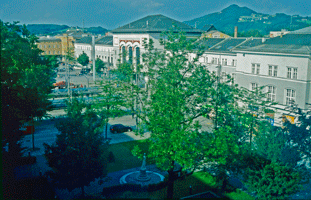
Salzburg is the fourth-largest city in Austria. In 2020 its population was 156,852. The city lies on the Salzach River, near the border with Germany and at the foot of the Alps mountains.
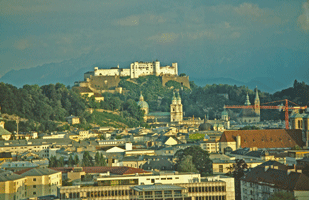
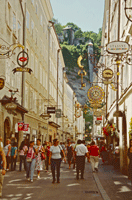
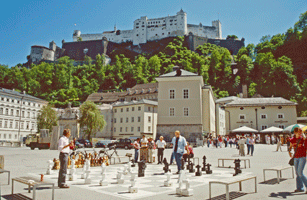
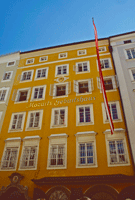
The fortress of Hohensalzburg, one of the largest medieval fortresses in Europe, dates from the 11th century. In the 17th century, Salzburg became a centre of the Counter-Reformation, with monasteries and numerous Baroque churches built. Salzburg has an extensive cultural and educational history, being the birthplace of Wolfgang Amadeus Mozart and being home to three universities and a large student population. Today, along with Vienna and the Tyrol, Salzburg is one of Austria's most popular tourist destinations.
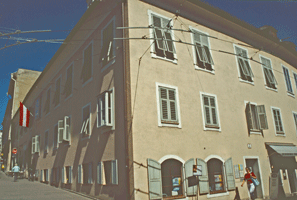
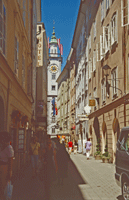
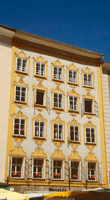
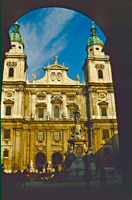
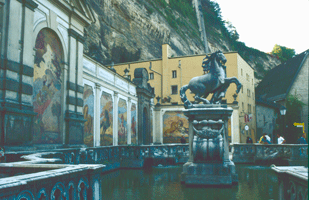
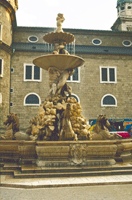
Salzburg's historic center (German: Altstadt) is renowned for its Baroque architecture and is one of the best-preserved city centres north of the Alps. The historic center was listed as a UNESCO World Heritage Site in 1996
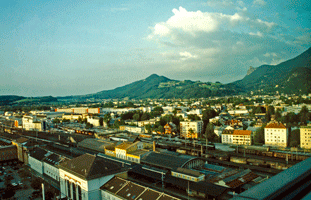
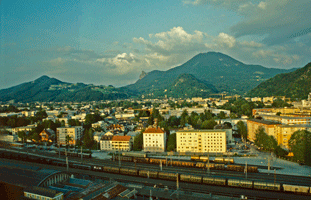
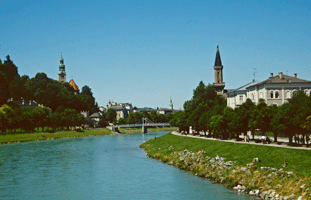
Salzburg is on the banks of the River Salzach, at the northern boundary of the Alps. The mountains to Salzburg's south contrast with the rolling plains to the north. The closest alpine peak, the 1,972-metre-high (6,470 ft.) Untersberg, is less than 16 km (10 miles) from the city center. The Altstadt, or "old town", is dominated by its baroque towers and churches and the massive Hohensalzburg Fortress. This area is flanked by two smaller hills, the Mönchsberg and Kapuzinerberg, which offer green relief within the city. Salzburg is approximately 150 km (93 miles) east of Munich, 281 km (175 miles) northwest of Ljubljana, Slovenia, and 300 km (186 miles) west of Vienna. Salzburg has about the same latitude as Seattle.
We visited here in September 1993 and June 2005.
HOVER over image for title. Click here to return to Austria Main Page.