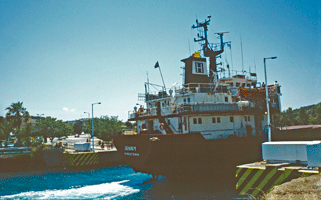
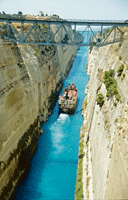
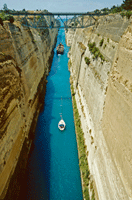
The Corinth Canal is a canal in Greece that connects the Gulf of Corinth in the Ionian Sea with the Saronic Gulf in the Aegean Sea. Completed in 1893, it cuts through the narrow Isthmus of Corinth and separates the Peloponnese peninsula from the Greek mainland. The canal was dug through the Isthmus at sea level and has no locks. It is 6.4 kilometres (4 miles) in length and at 24.6 metres (80.7 feet) wide at sea level is impassable for many modern ships. It is currently of little economic importance and is mainly a tourist attraction.
The sea-level canal consists of a single lock-free 6,343-metre (20,810 ft.) channel excavated 8 metres (26 ft.) deep, 24.6 metres (81 ft) in breadth at the surface, and 21.3 metres (70 ft.) wide at the bottom. The rock walls, which rise 90 metres (300 ft.) above sea level, are at a near-vertical 80° angle. The canal is crossed by a railway line, a road, and a motorway at a height of about 45 metres (148 ft.). In 1988, submersible bridges were installed at sea level at each end of the canal, by the eastern harbour of Isthmia and the western harbour of Poseidonia, providing two additional crossings for road traffic.
The canal saves a 700-kilometre (430 miles) journey around the Peloponnese for transiting vessels. It is too narrow and shallow for large, deep-drafted oceangoing vessels, accommodating a maximum of 17.6 metres (58 ft.) in width and 7.3 metres (24 ft.) in draft. In October 2019, the 22.5-metre-wide (74 ft.), 195-metre-long (640 ft.), 900-passenger cruise ship Braemar set a new record for longest ship to pass through the canal.
Ships can pass through the canal only one convoy at a time on a one-way system. Larger ships have to be towed by tugs. The canal is currently used mainly by tourist ships; around 11,000 ships per year travel through the waterway.
We visited here in June 2004.
HOVER over image for title. Click here to return to Greece Main Page.